Buying Guides
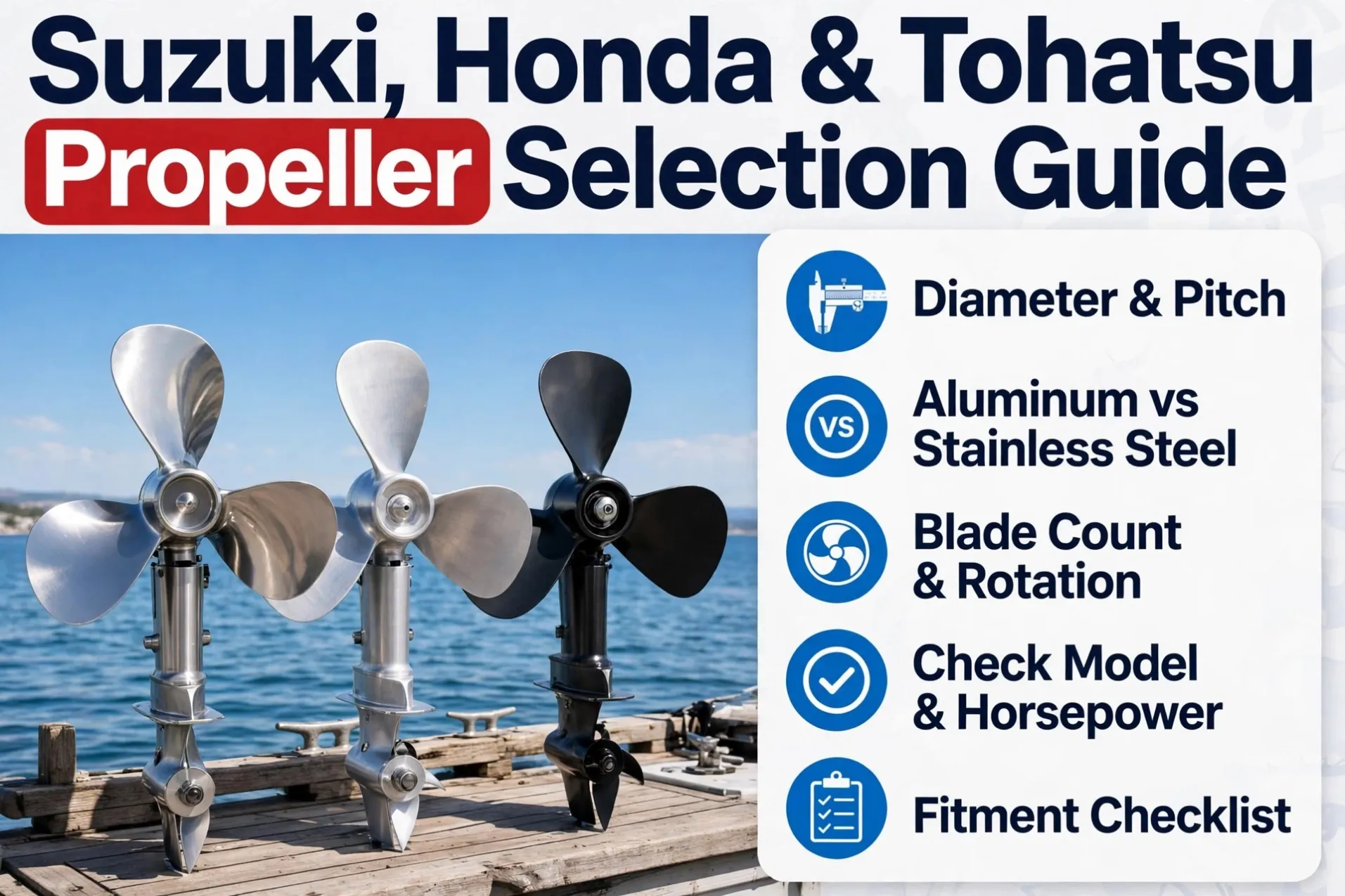
Suzuki, Honda & Tohatsu Propeller Selection Guide
How to pick the right propeller for Suzuki, Honda and Tohatsu outboards — diameter, pitch, material, blade and fitment checks, from SEABOND OUTBOARD.
Yamaha propellers already have their own guide on this site — see Yamaha Propeller Selection Guide. This guide covers the other brands we stock: Suzuki, Honda and Tohatsu.
The basic propeller selection principles are similar across brands — diameter, pitch, material and fitment — but the exact propeller application varies by engine model and configuration. Do not assume a propeller that fits one brand will fit another.
- Start with the Brand, Model and Horsepower
A propeller is designed for a specific engine and application range. Before ordering, confirm three things: the engine brand, model and horsepower.
A propeller listed for one HP range is not automatically correct for the next range up or down, even within the same brand. If you are buying for resale, ask your customer for the exact engine model and HP first.
A photo of the old propeller and its hub or part-number markings can also help confirm the application.
- Diameter and Pitch: What They Do
Diameter is the width of the circle formed by the propeller blades during rotation. Pitch is the theoretical distance the propeller would advance in one full revolution without slip, similar to the thread of a screw.
In general, a larger pitch can increase top-end speed but reduce acceleration, while a smaller pitch can improve acceleration and load-carrying ability at the expense of top-end speed.
As a general starting point, if the engine cannot reach its recommended full-throttle RPM under the intended load, a lower pitch may be appropriate. If the engine exceeds the recommended RPM range, a higher pitch may be appropriate.
Always use the engine manufacturer's recommended RPM range and consider the boat hull, load and operating conditions when selecting pitch. Tohatsu specifically notes that boat design, carrying load and intended use can affect propeller performance.
- Aluminum or Stainless Steel?
Aluminum propellers are lightweight, cost-effective and a practical choice for many small and mid-size outboards. They are widely used for general recreational and utility applications.
Stainless steel propellers are stronger and generally maintain their blade shape better under high load and speed. They cost more than aluminum and are often selected for demanding, high-performance or heavy-duty applications.
For wholesale buyers, stocking both aluminum and stainless steel options across popular HP ranges can help cover different customer requirements and budgets.
- What to Check for Each Brand
Suzuki outboard propeller 150-300HP: Confirm the exact engine model and horsepower first, then check the propeller diameter, pitch and hub/shaft fitment. Do not select a Suzuki outboard propeller 8-20HP — OEM 58100-91D00-019 based on horsepower alone.
Honda outboard propeller 115-250HP: Confirm the engine model and HP, then check the propeller diameter, pitch, rotation and hub/shaft fitment. Honda offers different Honda outboard propeller 8-20HP within some engine groups, so matching the exact application is important.
Tohatsu: Model and horsepower are especially important because different Tohatsu engines can use different propeller dimensions and applications. Confirm the diameter, pitch, blade count and hub/shaft fitment before ordering. Tohatsu's own propeller chart lists diameter, pitch, blade count and application information for its outboards.
For all three brands, also confirm propeller rotation and blade count. Three-blade propellers are common for general-purpose applications, while four-blade propellers can provide additional grip and smoother low-speed or heavy-load performance depending on the application.
- A Quick Checklist Before You Order
Before ordering an aftermarket propeller, prepare:
- Engine brand and exact model
- Horsepower
- Existing propeller diameter and pitch
- Blade count
- Hub and shaft fitment
- Rotation
- Aluminum or stainless steel
- Photo or markings from the existing propeller, if available
A propeller can look correct but still be incompatible with the engine shaft or hub system. Spending an extra minute checking the fitment can prevent an incorrect order.
For wholesale buyers, send us the engine model, horsepower, existing propeller markings and required material. We can help identify suitable aftermarket propeller options and provide pricing and catalog information.
At SEABOND OUTBOARD, we supply aluminum and stainless steel aftermarket propellers for Yamaha, Suzuki, Honda, Tohatsu and Mercury outboards.