Jun 26, 2026Buying Guides
Yamaha Propeller Selection Guide
This comprehensive guide breaks down the science of Yamaha propeller selection so you can make an informed, data-driven decision for your vessel.
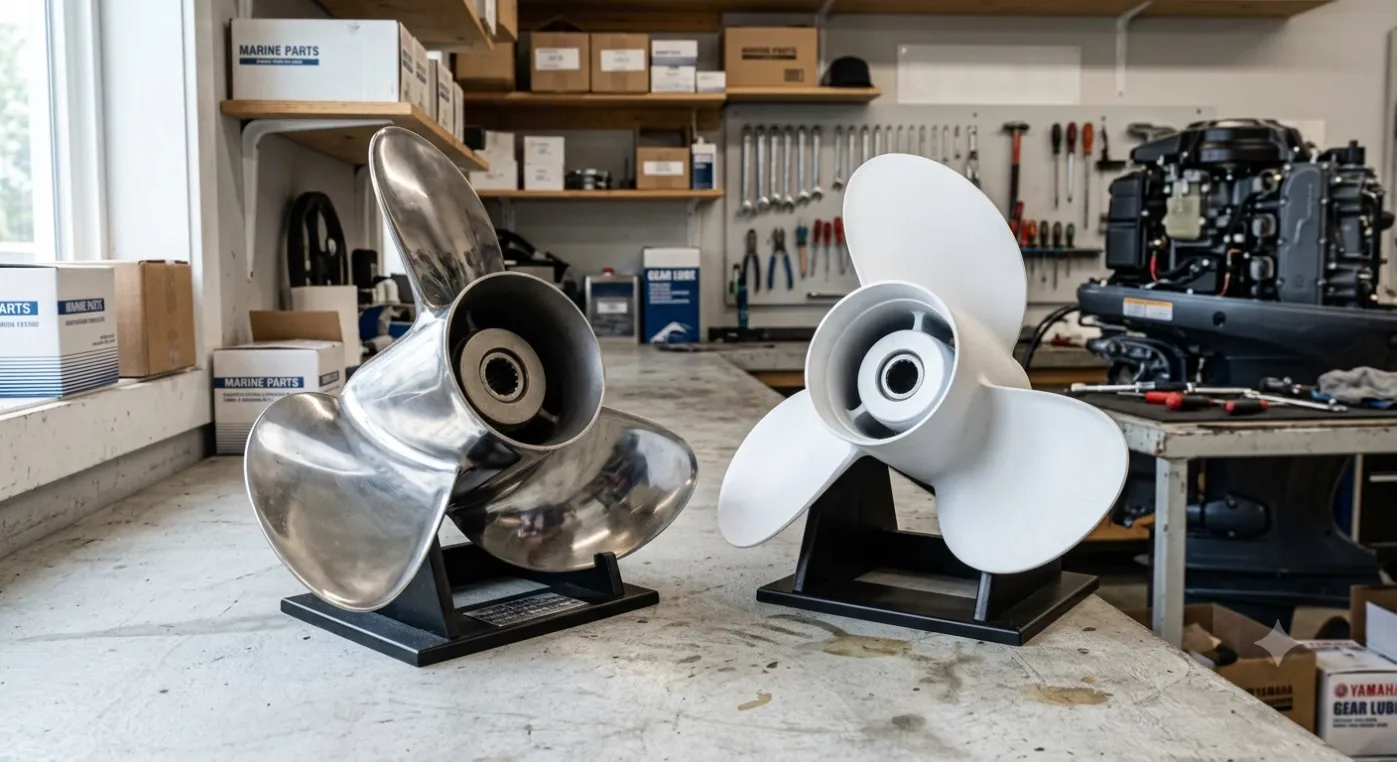
The Ultimate Yamaha Propeller Selection Guide: How to Optimize Your Outboard’s Performance
As a marine professional, commercial fleet operator, or dedicated boat owner, you know that your Yamaha outboard is only as good as the propeller attached to it. The right propeller acts as the perfect gear shift—maximizing fuel efficiency, increasing top-end speed, and ensuring the longevity of your engine.
Choosing the wrong propeller, however, can lead to chronic engine lugging, wasted fuel, or even catastrophic powerhead failure.
This comprehensive guide breaks down the science of Yamaha propeller selection so you can make an informed, data-driven decision for your vessel.
1. The Core Metrics: Understanding Pitch and Diameter
Every Yamaha propeller has its specifications stamped into the hub (e.g.,
13 3/4 x 21 - M). Understanding these numbers is your starting point.- Diameter: The total distance across the circle formed by the blade tips. Larger diameters lift heavier boats; smaller diameters are built for lighter, faster hulls.
- Pitch: The theoretical distance (in inches) a propeller would move forward through a solid medium in one full rotation.
- Lower Pitch (e.g., 15”): Acts like a car's first gear. It provides massive low-end torque, fast hole-shots, and excellent load-carrying capacity, but lower top speeds.
- Higher Pitch (e.g., 21”): Acts like overdrive. It delivers higher top-end speeds at lower RPMs, but struggles to push heavy loads from a dead stop.
The Golden Rule of Pitch vs. RPM: A change of 2 inches in pitch typically alters your engine speed by approximately 300 to 400 RPM. Decreasing pitch raises RPM; increasing pitch lowers it.
2. Aluminum vs. Stainless Steel: Which Material Fits Your Market?
Choosing the right material depends entirely on your operating environment and performance goals.
Material | Best Used For | Key Advantages | Disadvantages |
Premium Aluminum | Mid-range outboards (25hp - 115hp), rocky or shallow waters, cost-conscious fleets. | Affordable, easily repaired, sacrificial material protects the lower unit gearcase upon heavy impact. | Flexes under heavy loads, reducing top-end efficiency and bite. |
High-Performance Stainless Steel | High-horsepower outboards (150hp+), heavy offshore commercial boats, maximum speed applications. | Extreme durability, virtually no blade flex, thinner blades for less drag, better cup retention. | Higher initial cost, rigid construction transfers impact shock directly to the internal gea |
3. Step-by-Step: How to Select Your Next Yamaha Propeller
To find the absolute perfect match, avoid guessing. Follow this proven 3-step operational checklist:
Step 1: Find Your Engine’s Wide-Open Throttle (WOT) Range
Check your Yamaha owner's manual for the target WOT range. For most modern Yamaha 4-stroke outboards, this is between 5,000 and 6,000 RPM (or 5,500–6,300 RPM for high-output models).
Step 2: Conduct a Real-World Sea Trial
Take your boat out with your typical everyday load (full fuel, gear, and standard passenger weight). Push the throttle to maximum and note the maximum RPM on your tachometer.
- If your RPM is below the WOT range: Your engine is "lugging." You need to drop the propeller pitch.
- If your RPM exceeds the WOT range: Your engine is over-revving. You need to increase the propeller pitch to protect the engine.
Step 3: Match the Yamaha Hub and Series Designators
Yamaha categorizes its lower units by letter codes based on horsepower. Ensure your replacement prop matches your series:
- A Series: Small outboards (6hp - 20hp)
- G Series: Mid-range outboards (25hp - 60hp)
- K Series: The heavy-duty workhorses (60hp - 140hp, 4.25" Gearcase)
- M Series / T Series: High-horsepower V6 outboards (150hp - 300hp, 4.75" Gearcase)
4. Looking for Factory-Direct Quality Without the OEM Price Tag?
Finding a reliable supply chain that balances uncompromising quality with commercial viability can be a challenge.
We manufacture heavy-duty, factory-direct marine propellers engineered to meet and exceed strict OEM tolerances. Using advanced metallurgy—including aerospace-grade aluminum alloys and high-yield stainless steel—our propellers deliver identical performance, precise geometry, and exceptional corrosion resistance in harsh saltwater environments.
- 100% Interchangeable: Direct drop-in fitment for all Yamaha splined shafts.
- Rigorous Quality Control: Every propeller is dynamic-balance tested to eliminate lower-unit vibration.
- Global Wholesale Logistics: Optimized supply chain solutions for distributors, commercial fleets, and repair facilities worldwide.
Get an Instant Wholesale Quote & Fitment Guide
Not sure which K-Series or M-Series pitch will optimize your fleet's fuel economy? Contact our technical engineering support team today. Drop your engine model and boat weight below, and our specialists will provide a tailored fitment analysis within 24 hours.