Oct 12, 2026
B8HS-10 vs B7HS-10 Spark Plugs: Differences & Selection Guide
Compare B8HS-10 and B7HS-10 spark plugs, understand heat range differences, and learn how to choose the correct spark plug for your outboard motor.
B8HS-10 vs B7HS-10 Spark Plugs: What's the Difference and Which One Should You Choose?
Choosing the correct spark plug is essential for reliable outboard engine performance. If you own, maintain, or repair a Yamaha, Suzuki, or another outboard motor, you may have come across two common spark plug models: NGK B8HS-10 and B7HS-10.
Although these two spark plugs look similar, they have an important difference: their heat range.
In this guide, we explain the differences between B8HS-10 and B7HS-10, how to choose the right spark plug for your outboard motor, and what to check before purchasing a replacement.
1. B8HS-10 vs B7HS-10: Key Differences
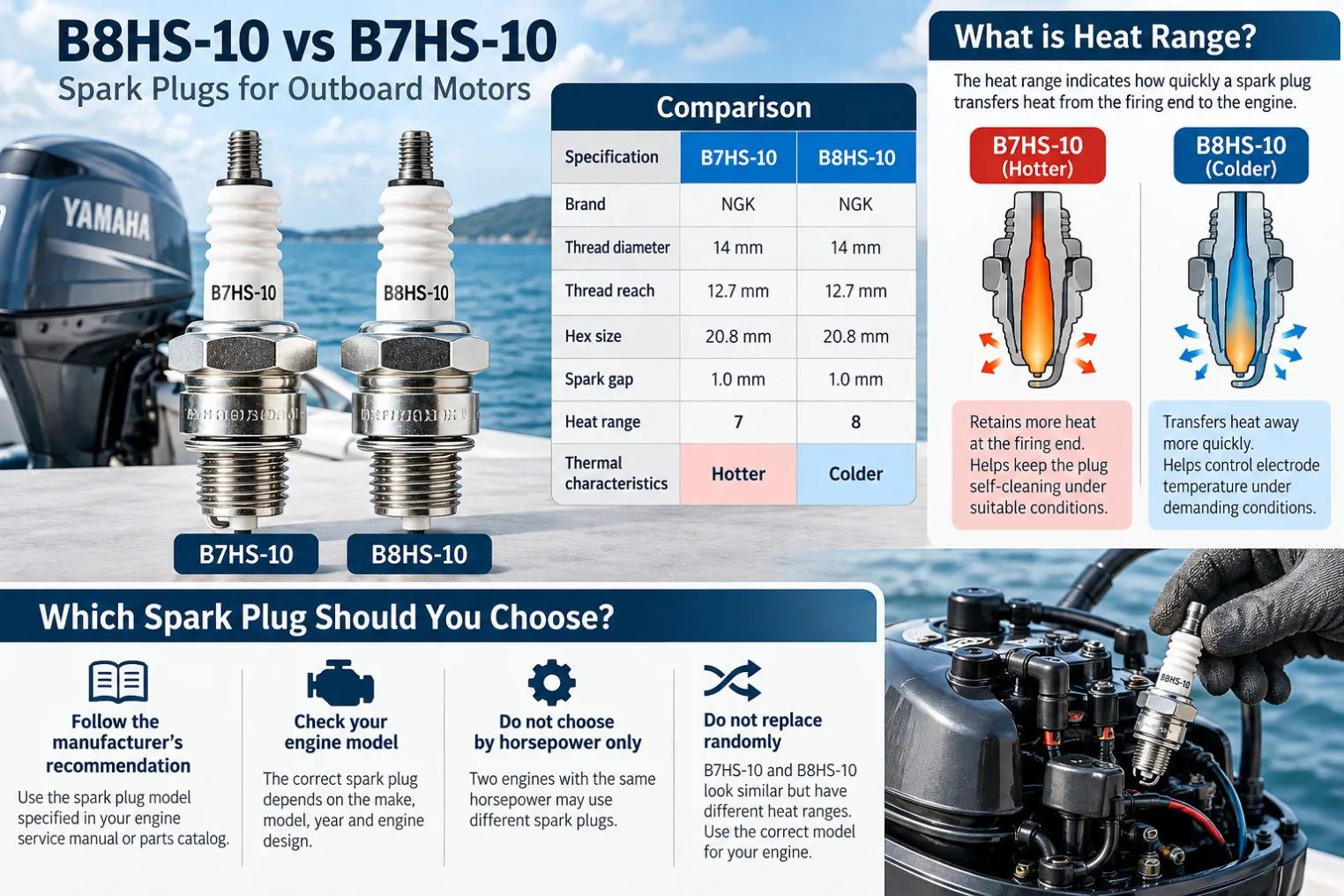
Both spark plugs belong to the NGK standard spark plug series. They share several key physical specifications, but their heat ranges are different.
Specification | B7HS-10 | B8HS-10 |
|---|---|---|
Spark plug type | Standard spark plug | Standard spark plug |
Thread diameter | 14 mm | 14 mm |
Thread reach | 12.7 mm | 12.7 mm |
Hex size | 20.8 mm | 20.8 mm |
Spark gap | 1.0 mm | 1.0 mm |
Heat range | 7 | 8 |
Thermal characteristics | Hotter | Colder |
The specifications above are based on NGK's published spark plug information. Always verify the required spark plug and gap against your engine's service manual.
The Main Difference: Heat Range
The most important difference is the heat range.
B7HS-10 is one heat range hotter than B8HS-10.
A hotter spark plug retains more heat at its firing end. This can help the plug reach its self-cleaning temperature under suitable operating conditions.
A colder spark plug transfers heat away from its firing end more quickly. This can help control electrode and insulator temperatures when the engine operates under demanding thermal conditions.
However, a colder plug is not automatically better, and a hotter plug is not automatically better. The correct choice depends on the engine's original specifications and operating conditions.
Using the wrong heat range may contribute to carbon fouling, overheating, or pre-ignition.
2. What Does the “-10” Mean?
The “-10” suffix is another important part of the spark plug code.
For these NGK spark plug models, the suffix indicates a nominal spark gap of 1.0 mm.
The spark gap is the distance between the center electrode and the ground electrode. It affects how the ignition system produces a spark.
An incorrect gap may contribute to starting difficulties, misfiring, or poor running performance.
Before installing a new spark plug, check the gap specified by the engine manufacturer. Do not assume that every outboard engine requires the same gap simply because it uses a B7HS-10 or B8HS-10 plug.
3. Which Spark Plug Is Right for Your Outboard Motor?
The best way to choose between B7HS-10 and B8HS-10 is to identify the exact engine application.
Choose B7HS-10 When the Manufacturer Specifies It
B7HS-10 may be the correct choice for an outboard engine whose service manual or official parts catalog specifies this model.
For example, NGK's application catalog lists B7HS-10 for certain Yamaha 20 HP two-cylinder outboard engines from 1996–1997.
This is an example of why checking the exact engine model and production year is more reliable than choosing a spark plug based only on horsepower.
Choose B8HS-10 When the Manufacturer Specifies It
B8HS-10 may be appropriate for an engine designed to use this colder heat range.
For engines that experience sustained high loads or elevated operating temperatures, the specified colder heat range may help manage spark plug firing-end temperatures. However, you should not switch from B7HS-10 to B8HS-10 solely because you operate at high RPM or carry heavy loads.
Always follow the engine manufacturer's recommendation unless a qualified technician or the manufacturer confirms that an alternative heat range is suitable.
Important: Horsepower Alone Is Not Enough
Two outboard motors with the same horsepower can have different ignition specifications.
The correct spark plug may depend on:
- Engine make and model
- Production year and serial number
- Two-stroke or four-stroke design
- Original ignition system specifications
- Manufacturer-recommended heat range and spark gap
Do not choose B7HS-10 or B8HS-10 simply because your engine is below or above a particular horsepower rating.
4. How to Check Whether You Have the Correct Spark Plug
If you are unsure which model your engine requires, follow these steps.
Step 1: Identify your engine.
Record the brand, horsepower, model number, and production year. If possible, note the serial number as well.
Step 2: Check the owner's manual or parts catalog.
Look for the original spark plug part number and recommended spark gap.
Step 3: Inspect the existing spark plug.
Read the code printed on the plug's metal body or ceramic insulator. Remember that the previous owner may have installed an incorrect replacement, so do not rely on the existing plug alone.
Step 4: Compare the specifications.
Confirm the thread diameter, thread reach, seat type, heat range, and spark gap. Similar-looking plugs are not necessarily interchangeable.
Step 5: Install and maintain it correctly.
Follow the manufacturer's installation procedure and tightening torque. Inspect spark plugs regularly and replace them when required by the maintenance schedule or their condition.
5. Common Spark Plug Problems and What They May Indicate
Spark plug appearance can provide useful diagnostic information, although it should not be used alone to diagnose an engine problem.
- Black, dry carbon deposits: May indicate a plug that is too cold for the application, an overly rich fuel mixture, prolonged low-speed operation, or an ignition problem.
- Blistered or overheated insulator: May indicate excessive operating temperature, an unsuitable heat range, incorrect ignition timing, or a cooling or fuel-mixture problem.
- Wet or oily deposits: May be associated with oil fouling, incomplete combustion, or other engine-related issues.
- Repeated misfiring or difficult starting: May be related to spark plug condition, the electrode gap, ignition components, fuel delivery, or compression.
If the same problem continues after replacing the spark plug, investigate the underlying cause instead of repeatedly changing to a different heat range.
6. Frequently Asked Questions
Can I replace B7HS-10 with B8HS-10?
Not automatically. Although they share key physical dimensions and a nominal 1.0 mm gap, B8HS-10 is one heat range colder. Use it only if the engine manufacturer or a qualified technician confirms compatibility.
Is B8HS-10 better than B7HS-10?
Neither is universally better. Each is designed for a particular thermal operating range. The correct spark plug is the one specified for your engine.
Do these spark plugs fit every Yamaha outboard motor?
No. Compatibility depends on the exact engine model and specifications. Do not assume that every Yamaha engine, or every engine from another manufacturer, can use either plug.
Should I adjust the spark gap before installation?
Check the manufacturer's specified gap first. Both models have a nominal 1.0 mm gap, but the required gap must be confirmed for your specific engine. Handle the electrodes carefully when checking or adjusting the gap.
When should I replace my outboard spark plugs?
Follow the maintenance interval in your engine's service manual. Replace spark plugs earlier if they are damaged, excessively worn, or fouled and cannot be restored to proper operating condition.
7. Need B7HS-10 or B8HS-10 Spark Plugs for Your Business?
Selecting the correct spark plug helps support reliable engine operation and reduces the risk of using an unsuitable replacement part.
At Tianjin Kaiyueda Bearing Trading Co., Ltd., we supply outboard motor spare parts for international customers, including marine engine maintenance and replacement components.
Whether you are a marine repair shop, spare parts distributor, importer, or wholesaler, confirming the correct part number before ordering is essential.
Contact us for spark plug inquiries and outboard motor spare parts supply.
Please provide your engine brand, horsepower, model number, or original spark plug code so that compatibility can be checked before ordering.